


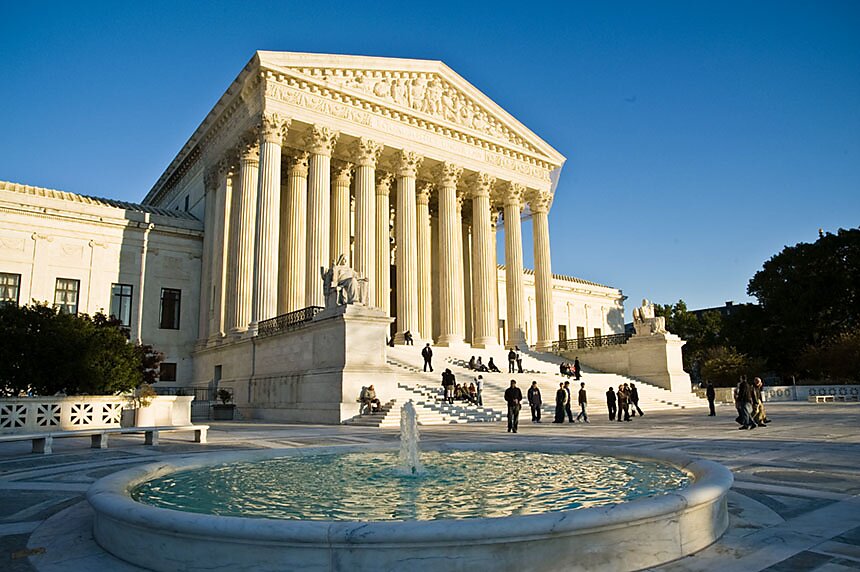
In a major setback for the Trump administration, the Supreme Court, in an unsigned opinion on December 23, declined to stay a lower court order barring the federal government from deploying the National Guard in Chicago. While welcome, the ruling is also in some ways narrow and kicks down the road many important issues. One of those issues, to my mind, is whether to rethink the presumption of regularity from which the federal government has long benefited as a litigant.
First, however, a few paragraphs on the ruling generally. To begin with, it conspicuously breaks the pattern by which the Court keeps granting the Trump administration stays of lower court rulings that restrain the administration’s ambitious assertions of presidential powers, thus allowing the power assertions to continue pending later court action. The split was 6–3 with a few wrinkles (Justice Brett Kavanaugh joined the majority but would have decided the case more narrowly. Justice Neil Gorsuch did not join the strongly written dissent by Justices Samuel Alito and Clarence Thomas and instead dissented more narrowly.)
The majority’s logic appears to carry over to some of Trump’s other deployments of the National Guard, and a week later, the administration announced that it was ending Guard deployments in Los Angeles and Portland, which had come under similar rebuffs at the lower court level. The terse majority opinion places much weight on an issue few initially saw as critical: how to interpret the use of the term “regular forces” in language empowering the president to federalize the Guard if he is “unable with the regular forces” to execute federal law. It also speaks the language of dry textualism rather than philosophical vision; Adam Unikowsky writes to explain why he sees that as a good thing.
Jack Goldsmith has offered a plausible analysis of some of the other issues in the case. Briefly: Trump retains many options not addressed by the Court; the statutory interpretation issues that the Court kicked down the road are quite complex; and the Court has not tipped its hand as to where it will come down on the inherent protective power theory cited by Trump and his backers as an argument for not needing any statutory basis at all for at least some of his troop deployments.
All that said, much of the division appears to hinge on a distinctively factual question: Is the city of Chicago so gripped by anti-government mob violence as to make it impractical for the president to reestablish order through regular means? The majority evidently leans toward thinking one thing, Alito and Thomas another, with Gorsuch and Kavanaugh somewhere in between.
On an intensely fact-laden question like this, where do we expect the Justices to draw their facts? The traditional answer is “from the record,” in this case the district court record, on which after hearing extensive testimony, Judge Sara Ellis not only rejected many factual contentions advanced by the government but even called some of them lies.
Justice Alito strongly disagrees with the district court’s approach, saying the factual determination should be left to the president. But he goes further. On page eight of his dissent, he goes on to cite a “widely publicized event” in which federal vehicles in Chicago were allegedly put in danger by civilian vehicles, “forcing the agent to fire in self-defense.”
This appears to refer to an October 2025 road incident in which a Border Patrol agent shot Marimar Martinez seven times, supposedly because she was directing her car at him. It’s true that the Department of Homeland Security’s (DHS) claim that the agent fired in self-defense did get “widely publicized,” which is what usually happens to the story the department puts out after its agents harm someone. It didn’t take long, however, before DHS’s story collapsed, after which the government withdrew charges against Martinez and a second defendant. Alito seems unaware of these later developments, the latter of which occurred a month before the Court’s decision.
On page 11 of his dissent, Alito gets to perhaps his core argument: Courts should defer to the president’s determination on the relevant trigger for lawful deployment (whether “the regular forces of the United States are not sufficient to ensure the laws of the United States are faithfully executed … in Chicago”) because “under the presumption of regularity, the Court must presume that the President properly arrived at his determination.”
What is the presumption of regularity? An important multiauthored article at Just Security explains that it
is a judicially created doctrine with a long and contested history. The doctrine affords the executive branch a distinctive advantage not enjoyed by private litigants. It generally instructs courts to presume, unless there is clear evidence to the contrary, that executive officials have “properly discharged their official duties” and that government agencies have acted with procedural regularity and with bona fide, non-pretextual reasons.
For reasons both procedural and substantive, this convenient presumption helps the government prevail over many legal challenges and escape scrutiny entirely on others. Perhaps (or perhaps not) at some point in the past, the conduct of America’s executive branch was so upright and beyond reproach as to make judges feel comfortable in presuming good motivation and lawfulness. But this past year? The Just Security survey compiles dozens of instances over the past year in which the executive’s representations to courts or actions in connection with them have been in bad faith, motivated by retaliation, arbitrary or capricious, in defiance of court orders or established law, or—again and again—baldly untruthful. Others have compiled shorter lists, sometimes based on the government’s misconduct before individual judges such as James Boasburg (D.D.C.) and Paula Xinis (D. Md.); I assembled a few in my piece on contempt of court way back in May 2025.
It all cries out for the Court as a whole to reevaluate whether the current executive has behaved with such rectitude as to continue to merit the old presumption of regularity. To be sure, last month’s majority decision bypassed that question and resolved the stay issue on other grounds. But I hope litigants before the Court press it in future.