

Scott Lincicome, Alfredo Carrillo Obregon, and Chad Smitson
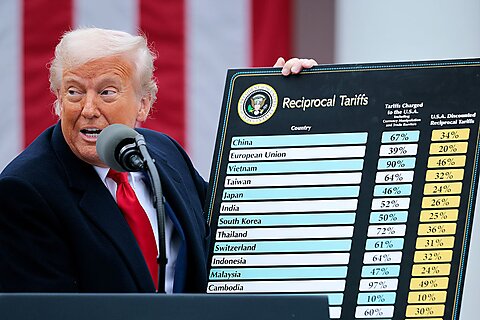
One year ago today, President Trump celebrated “Liberation Day,” unveiling his global “reciprocal” tariffs, heralding the “economic independence” of the United States, and promising the rebirth of American industry and a “golden age” of economic growth and lower prices.
Safe to say, things didn’t exactly work out as promised.
There are surely some things we still don’t know about the president’s tariffs, but 12 months of data and analysis have given us plenty of things we do know—at least at year one. So, to celebrate the first anniversary of “Liberation Day,” we’re providing a handy list of both what we know so far and the important issues yet to be determined.
The Knowns
1. The “global” tariffs became riddled with exemptions
Contrary to the president’s early claims that there would be no exemptions from his global tariff regime, numerous product exemptions were issued throughout 2025. Because of these exemptions, the applied “reciprocal” tariff rate fell from 21.5 percent to 13.6 percent by the time of the Supreme Court’s ruling. Moreover, 43 percent of US imports avoided all tariffs imposed in 2025, including the reciprocal tariffs.

As Figure 1 below shows, moreover, as many as 64 percent of US imports (based on 2025 values) are now exempt from the replacement Section 122 tariffs, which retain most of the reciprocal tariffs’ exemptions. Most notable among the exemptions is, as economist Joey Politano first noticed last year, semiconductors, computers, and related goods that the booming US artificial intelligence industry needs. The loopholes help to explain why the tariffs were not as costly as many experts feared in April 2025.

2. Tariff-related lobbying exploded
The exemptions also help to explain another thing we know about Trump’s tariff regime: tariff-related lobbying activity—driven by the chance to win an exemption or new restrictions on overseas competitors’ goods—reached levels not seen in years, if not decades. The number of registered clients for tariff-related lobbying increased by 218 percent in 2025 with respect to the previous year, the biggest year-on-year change since Trump’s first term in 2018 (Figure 2). Meanwhile, trade-related lobbying expenditures reached more than $900 million in the first half of 2025 alone and were 28 percent higher than in the first half of 2024.

3. The tariffs raised prices
Notwithstanding the tariff exemptions, the duties undeniably increased prices for American importers and consumers. Economic research shows that the higher costs from tariffs passed through to prices paid by Americans at a rate as high as 96 percent. The administration and tariff defenders often cite that tariffs did not lead to an inflationary spiral, but—as many economists have repeatedly explained—that outcome was never a serious possibility. What was likely—and what did indeed happen—is that tariffs increased the prices of tariffed goods (imported and domestic) last year, and they remain elevated today. Economists from Harvard Business School have examined thousands of items sold at major US retailers and found significant increases in their prices—especially as compared to pre-tariff trends (Figure 3). Other studies have reached similar conclusions.

4. Trade policy uncertainty skyrocketed
The tariffs also imposed “unseen” costs on Americans. One such cost is uncertainty surrounding US trade policy, which has resulted from the dozens of changes to US tariffs that the president unilaterally enacted or threatened last year. Scholars have unsurprisingly calculated that policy uncertainty reached an all-time high in 2025—by a large margin (Figure 4). And multiple business surveys and anecdotes suggest that this uncertainty, fueled by the unilateral and haphazard way in which the tariffs were applied, undermined long-term business planning and investment in the United States.

5. The US tariff system became significantly more complex and opaque
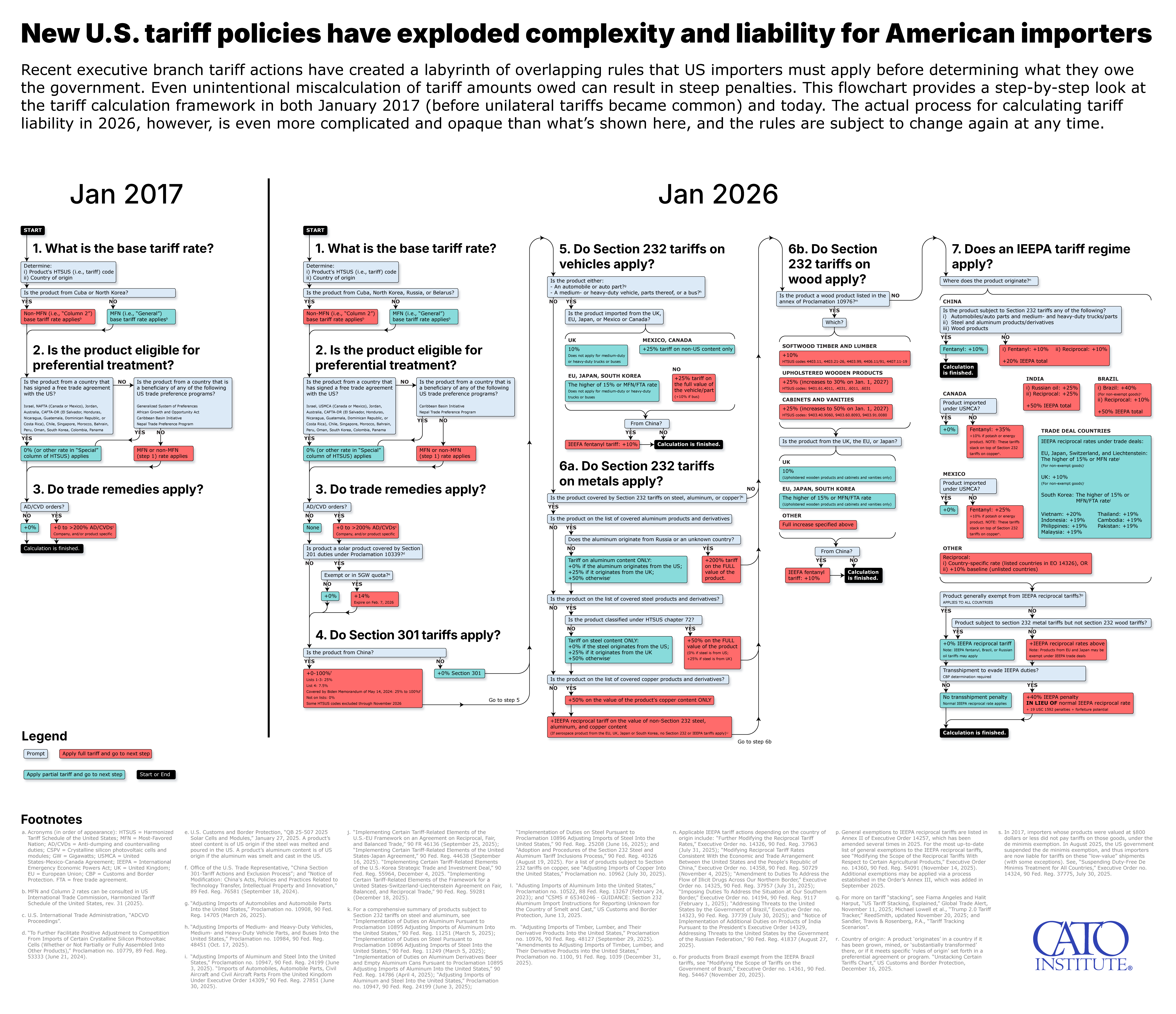
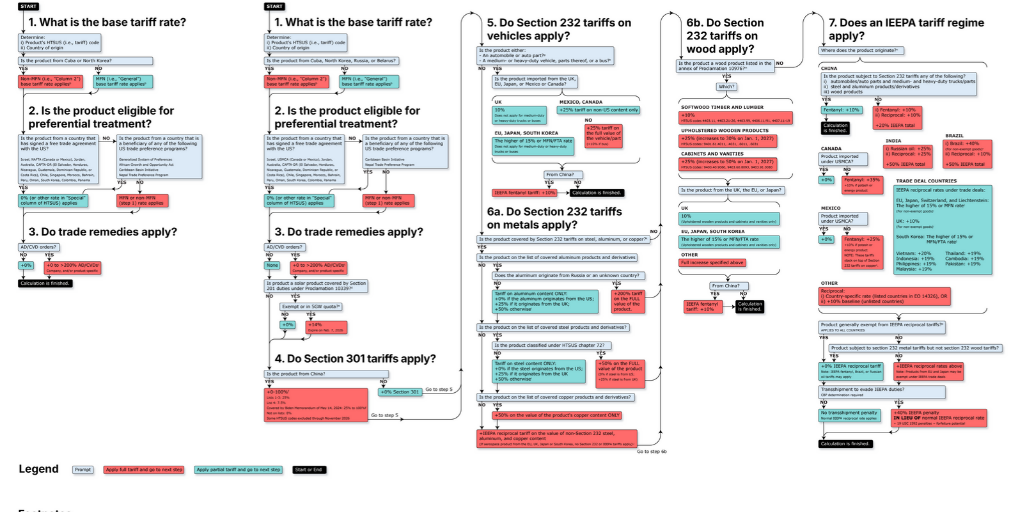
Another significant “unseen” cost of the president’s tariff policies is the degree to which they made the US tariff schedule more difficult—if not almost impossible—to navigate for American importers and even seasoned customs experts. Proof of the system’s complexity is the fact that the US tariff schedule underwent 50 changes last year, and that 66 percent of total US imports entered under a special, temporary tariff provision (i.e. under Chapter 99). The chart below, meanwhile, is a simplified depiction of the US tariff system one month before the Supreme Court ruling. The costs of complying with complex regulations on calculating combined tariff rates and reporting the value and country of origin of certain components, and the prospect of significant civil (and even, criminal) penalties acts as an additional barrier to importation—one that disproportionately affects small businesses.
6. Manufacturing jobs did not boom and, in fact, kept declining
Manufacturers reported throughout 2025 that tariff-induced cost pressures and uncertainty hampered economic activity in the sector, and employment data suggest that this also contributed to a slowdown in hiring. While manufacturing employment indeed struggled throughout 2024, the data confirm that—contrary to White House promises—there was no tariff-related hiring boom in 2025 (Figure 5).

7. The US trade deficit did not decline
The “reciprocal” tariffs were explicitly imposed to reduce the US trade deficit, but it reached an all-time high (in real terms) last year (Figure 6). This is in part due to the fact that businesses anticipated Trump’s tariffs and rushed imports into the United States before the taxes were implemented—and then rushed in more when various tariff reprieves were announced (hence, why longer-term views of the data are important, as opposed to a small snapshot).

Another thing distorting the data has been trade in physical gold, and removing it smooths out the trade balance numbers throughout the last year (Figure 7). As the chart shows, the US ended 2025 roughly where it started.

8. Other countries are deepening trade ties without the United States
The US has not negotiated any free trade agreements (FTAs) since 2020, and since then, other countries—including some of America’s largest trading partners and long-standing allies—have negotiated and entered into many such deals (Figure 8). In just the last few months, for example, the EU has inked traditional trade deals with MERCOSUR, India, and Australia; Canada has launched negotiations with Thailand and the Philippines and is working on an FTA with ASEAN; China inked agreements with ASEAN and Congo, and is updating its FTA with South Korea; and even India, which had long been skeptic of FTAs, reached agreements with the United Kingdom and New Zealand.

As Cato scholars have explained, these trade agreements are not only more durable, detailed, and comprehensive than the Trump administration’s unratified trade deal “term sheets,” they also demonstrate that high, harmful tariffs are not needed to enter into trade liberalizing agreements that lower other countries’ barriers to US goods, services, and investment. With the administration’s tariffs undermining US commitments under previously negotiated trade agreements, we should expect non-US trade agreements to continue to proliferate in the future.
9. Tariff-related litigation has surged
Importers swiftly filed suits against the administration’s invocation of IEEPA to impose the “reciprocal” tariffs and other emergency duties, culminating in the Supreme Court’s landmark ruling against such tariffs on February 20. Ahead of and after the ruling, though, more than 2,000 importers filed suit to obtain refunds for more than $160 billion in tariffs paid to the federal government, plus interest.

10. Foreign investment did not boom
Despite the president’s Liberation Day prediction of a boom in foreign direct investment (FDI), quarterly FDI has fallen since April 2025, with the US registering $72.49 billion in FDI in Q4 (Figure 9). Total FDI in 2025 was $288.4 billion, lower than the annual totals from 2021 through 2024, and far short of the rate needed to reach the president’s lofty goal of $18 trillion in investment. New FDI last year was even lower. Several firms and countries have pledged to increase their investments in the US, but such pledges do not show up in data.

The Unknowns
1. Will the government refund the duties it illegally collected?
As noted above, the government has illegally collected more than $160 billion in IEEPA tariffs, most of them pursuant to the “reciprocal” tariffs. Given the possibility for prolonged litigation or a less-than-straightforward refund process, it’s too early to estimate when importers will get their money back, and how much of it they will get. Adding insult to injury, US taxpayers are on the hook for about $700 million dollars in additional interest payments for every month that refunds get delayed (Figure 10).

2. Will foreign countries fulfill their investment pledges?
The White House claims that certain foreign countries have pledged trillions in new investments in the United States. While some of this investment will likely occur, there are several reasons to doubt the coming investment boom. For example, total foreign direct investment in the US (on a historical-cost basis) reached $6.8 trillion at the end of 2024, and the FDI amounts pledged by most of the countries listed on the White House’s registry exceed their total FDI stocks in the United States (Figure 11).

3. (How) will the president rebuild his tariff wall?
With IEEPA overruled, the president temporarily turned to Section 122 of the Trade Act of 1974 to impose a 150-day, “global” (albeit with myriad exceptions) 10 percent tariff. In recent weeks, the administration launched two investigations under Section 301 of the same law to target foreign countries’ practices related to overcapacity and forced labor. Meanwhile, investigations on products that allegedly threaten to impair US national security are pending under Section 232 of the Trade Expansion Act of 1962. As Cato scholars have long warned, even without IEEPA, the Trump administration has various legal tools to recreate the “reciprocal” tariff regime—and courts may be less keen to overrule them. Tariff complexity, however, will surely increase (Figure 12).

Conclusion
Based on the available facts, “Liberation Day” did not herald the era of economic prosperity that the president promised. Taxes, prices, uncertainty, and bureaucracy climbed, while US manufacturing, FDI, and the trade balance stood still. Exemptions proliferated; lobbying skyrocketed; and most Americans were worse off. There’s still much we don’t know about US tariff policy going forward, but there’s certainly one thing we do: While the “reciprocal tariffs” may be dead, the administration’s protectionism will—barring congressional intervention—unfortunately persist.