




A new paper released today, Trends in Higher Education: State Funding and Tuition Revenue at Public Colleges from 1980 to 2025, documents state funding, tuition revenue, and total revenue at public colleges over the past 46 years.
There are four main findings.
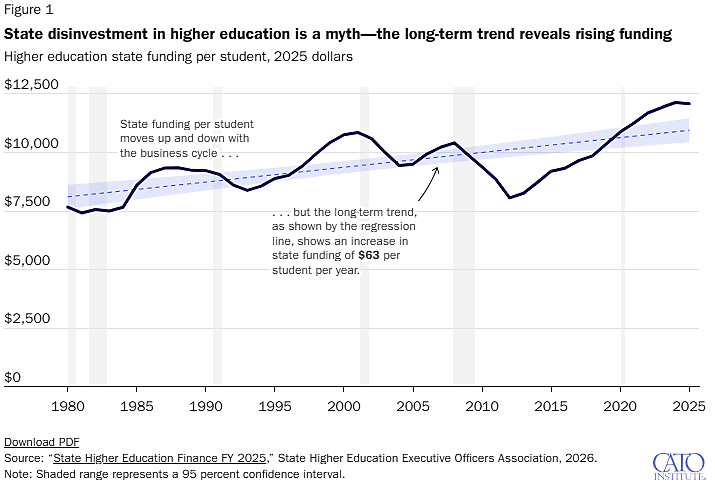
First, the conventional wisdom that states have been disinvesting in higher education for decades is a myth. Indeed, states have been increasing funding over time, not decreasing it, as shown in the figure below.
Second, tuition revenue rose relentlessly for decades but is now falling.

Third, total revenue rose consistently for decades, with small dips during recessions, but has now plateaued.

Fourth, the relationship between changes in state funding and changes in tuition revenue is very weak. This means that the conventional wisdom that tuition rises to make up for cuts in state funding is wrong. As the report notes
if tuition were adjusted to offset changes in state funding, then tuition should have been falling, not rising. For example, in 1980, inflation-adjusted state funding per student was $7,677, and in 2025, it was $12,081, an increase of $4,404. If changes in tuition are driven by changes in state funding, then tuition should have declined by $4,404, but it rose by $5,430 (from $2,029 to $7,459), a difference of $9,834.
The weak relationship between changes in state funding and changes in tuition revenue can also be seen in the figure below. The red line shows the predicted relationship if tuition revenue merely offsets changes in state funding dollar-for-dollar. The blue line shows the actual relationship. In other words, the conventional wisdom holds that a $1 decrease in state funding will increase tuition revenue by $1, but in reality, tuition revenue only increases by $0.02 to $0.29.

The already weak relationship between changes in state funding and changes in tuition revenue disappears entirely when looking at the state level rather than nationally. States that experienced dramatic changes in state funding showed similar changes in tuition revenue. For example, increases in state funding varied widely between Oklahoma (+$1,400), Virginia (+$2,900), Maryland (+$6,900), Massachusetts (+$8,100), and Illinois (+$14,700), yet all saw essentially the same change in tuition revenue of around $7,500.

There are two main takeaways from this weak relationship. First, those who believe tuition rose to make up for state disinvestment are wrong on two counts—state funding has been increasing, not falling, and the relationship between the two is very weak. Second, states shouldn’t try to “buy” lower tuition with more state funding. It would cost states $1 to save their students $0.02 to $0.29.
For more details on these and other related points, read the full paper here.