





The Jones Act rests upon a tacit bargain: Americans pay higher costs because of the law’s prohibition on foreign-built and internationally flagged ships transporting goods within the United States, and in exchange, they receive what the Shipbuilders Council of America describes as a “robust and competitive” domestic shipyard industrial base. But new data from the United Nations Conference on Trade and Development reveal how thoroughly that bargain has been broken.
In 2025, the United States ranked 19th in commercial shipbuilding output, accounting for just 0.03 percent of global gross tonnage delivered. The shipbuilding output of the world’s second-largest manufacturing country is measured in the hundredths of a percent. The United States was not just behind the shipbuilding powerhouses of China, South Korea, and Japan, but also far smaller countries. It was outproduced by Poland, Romania, and the Iberian Peninsula (Spain and Portugal combined). It delivered only 6 percent more gross tonnage than Croatia.
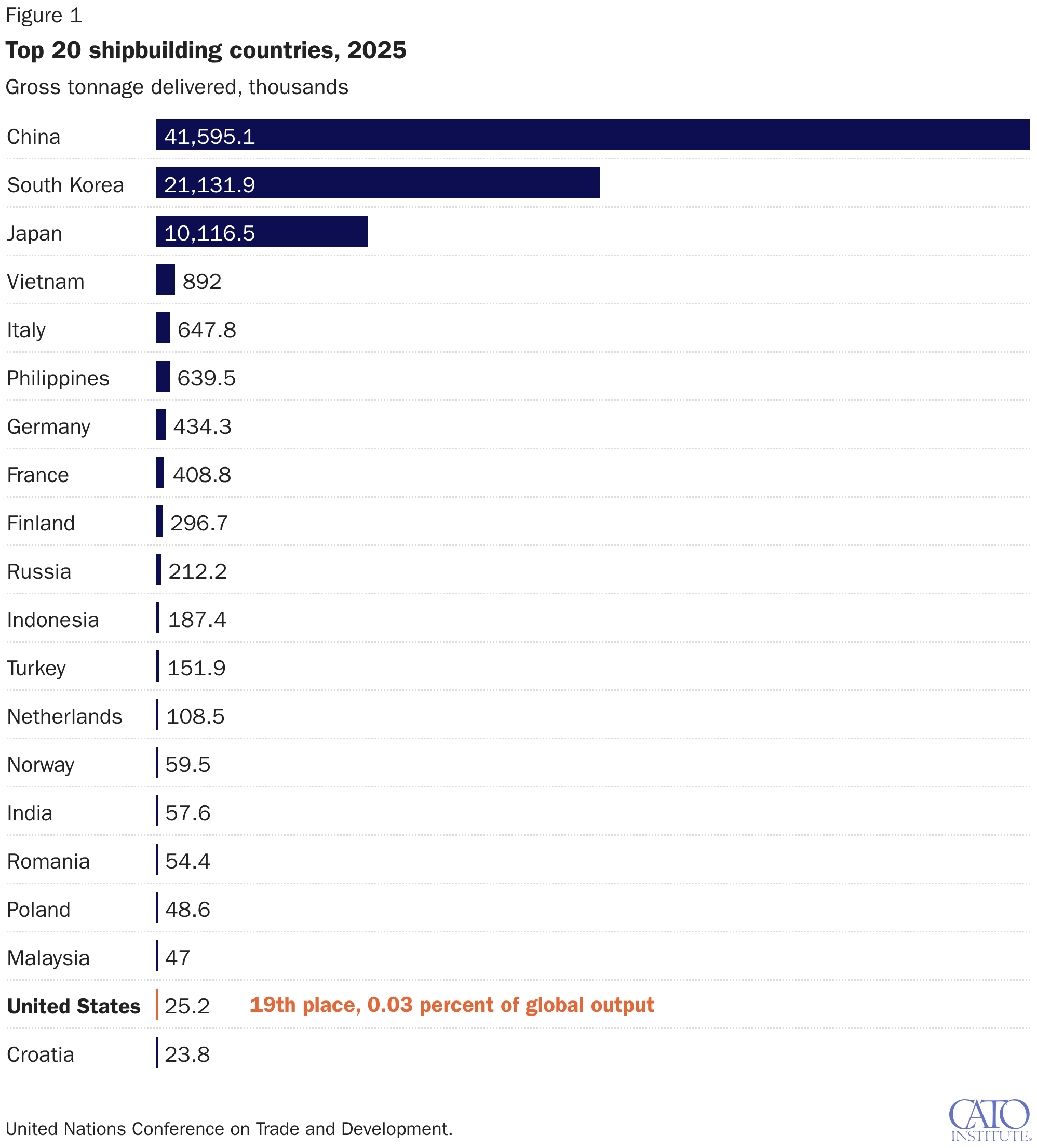
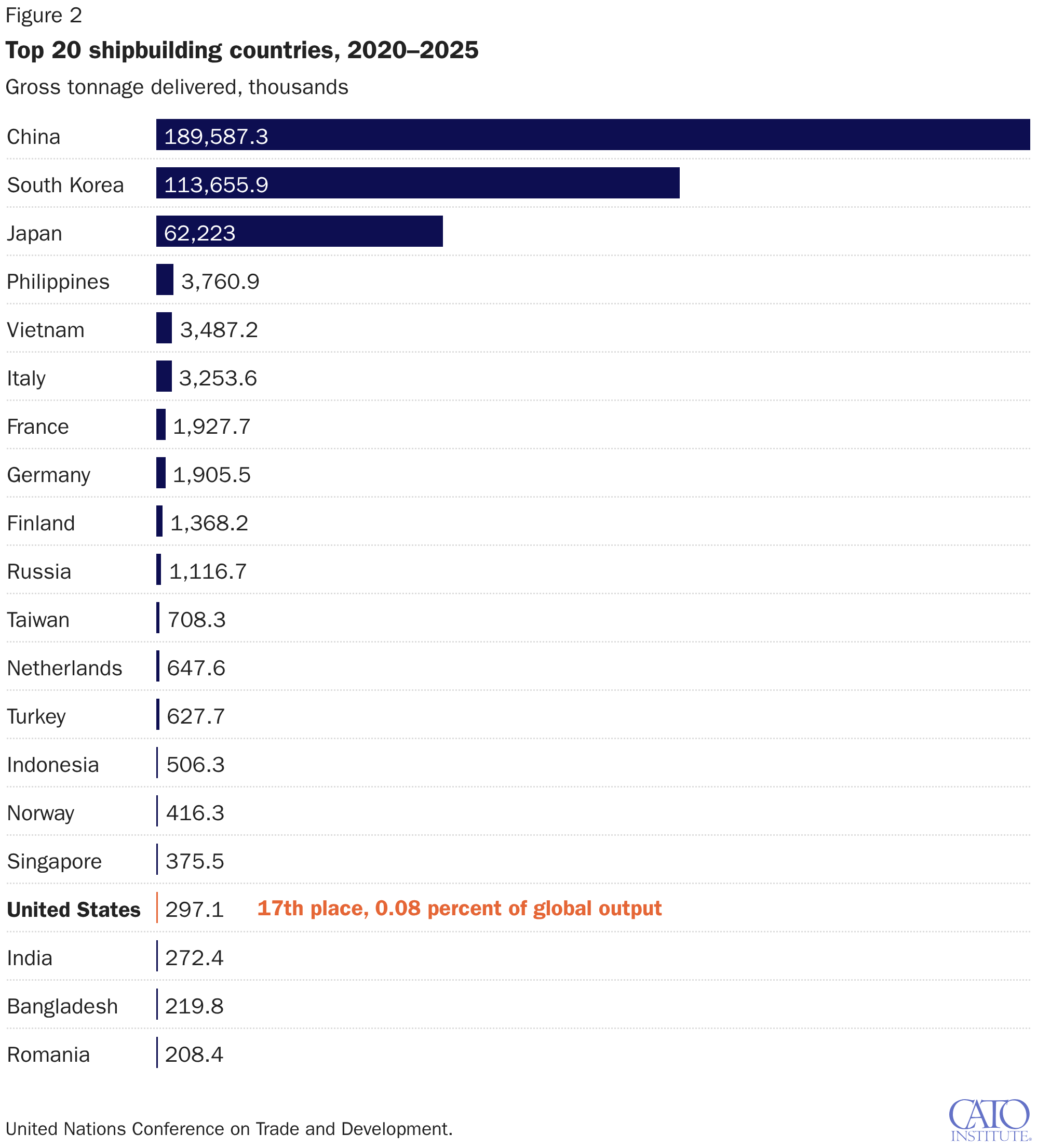
This snapshot is not an anomaly. In 2024, the United States also ranked 19th, with 0.04 percent of global output. So far this decade, the figure stands at 0.08 percent. From 2020 to 2025, 16 countries have outbuilt the United States, including the Netherlands, Norway, and Singapore (the last two of which each have populations smaller than the metro Atlanta region). Such numbers underscore the Navy’s fiscal year 2025 shipbuilding plan, as cited by the Government Accountability Office, that US commercial shipbuilding has experienced a “near-total collapse.”
There is no mystery behind this performance. US shipbuilding costs are so far out of line with global prices that demand has shriveled accordingly. Energy infrastructure company Kinder Morgan estimates that a US-built medium-range tanker would cost at least $240 million — a hypothetical, since no such vessel has actually been delivered by an American shipyard since 2017 — compared to $51 million abroad. Three containerships currently under construction in Philadelphia for Matson Navigation are running over $335 million apiece, against a maximum of $75 million to build the same ships overseas.
Such staggering cost premiums mean little demand for US-built vessels, not only for export but even within the captive domestic market. Rather than purchase new ships, for example, Jones Act carrier Pasha Hawaii has dispatched both of its 1980-built containerships to China to have their engines upgraded from steam to liquefied natural gas. The company points out that its ship, George II, was the first vessel in the world to undergo such a conversion. That distinction exists only because, in any other country, the ship would have been scrapped long ago and replaced with new construction (the average age of containerships in the global fleet is around 14 years). George II’s 1980-built sister ship, Horizon Spirit, was towed from California to China last year for its own conversion.
Overseas Shipholding Group tells a similar story. Rather than building new ships, the company is pouring over $60 million into repowering its Alaska-class tankers — the newest of which dates to 2006 — to keep them running well into the future. The US Maritime Administration places the nominal service life of a tanker at 20 years, and the Wall Street Journal recently noted that 15 is the age at which tankers begin to see their parts breaking down. Yet OSG’s chief operating officer has indicated that the company intends to run its tankers until age 40.
The pattern extends beyond cargo ships, with the offshore wind sector and ferry services likewise opting to repurpose aging vessels rather than order new ones.
The Jones Act’s protectionist logic holds that shielding the US commercial shipbuilding industry from foreign competition ensures its strength. The evidence is an unambiguous refutation. At 0.03 percent of global output, the notion that the United States would somehow fare even worse without the Jones Act requires believing that a country home to the world’s largest economy and long renowned for its dynamism and innovation would have no commercial shipbuilding at all. It is a proposition that strains credulity.
By any objective standard, the Jones Act has failed. The shipyard industrial base is neither robust nor competitive. Forbidding Americans from using vastly cheaper foreign-built vessels in domestic commerce in exchange for shipbuilding that hovers barely above zero does not make sense. The bargain is broken, and American consumers and businesses — and even the maritime industry the Jones Act ostensibly exists to promote — are paying for it.