





On June 24, the White House requested $87.6 billion in emergency supplemental funding. Most of the request—some $72 billion—is ostensibly related to the war in Iran. But a significant share has nothing to do with the war, ranging from $11 billion in agricultural subsidies to $1 billion to modernize New York City’s Penn Station. Legislators should not reward the administration for prosecuting an expensive war of aggression against Congress’s will. Congress should reject the request; short of that, it should demand dollar-for-dollar offsets for any new spending.
What’s in the Supplemental Funding Request?
Because Congress has already finalized its FY2026 appropriations, the administration has turned to an emergency supplemental. Such requests traditionally receive expedited consideration and less scrutiny. To prevent abuse, emergency spending is supposed to meet a five-part AND test, meaning that an emergency designation must be:
- necessary (essential or vital, not merely useful or beneficial);
- sudden (coming into being quickly, not building up over time);
- urgent (requiring immediate action);
- unforeseen; and
- not permanent.
Yet, Congress routinely ignores this test, abuses this emergency spending process, includes non-emergency spending requests, and adds trillions of dollars to the public debt using the “emergency” label. This latest emergency request is more of the same. Table 1 breaks down the White House’s $87.6 billion request into four buckets: the war in Iran, farm subsidies, Ebola response, and government pork.
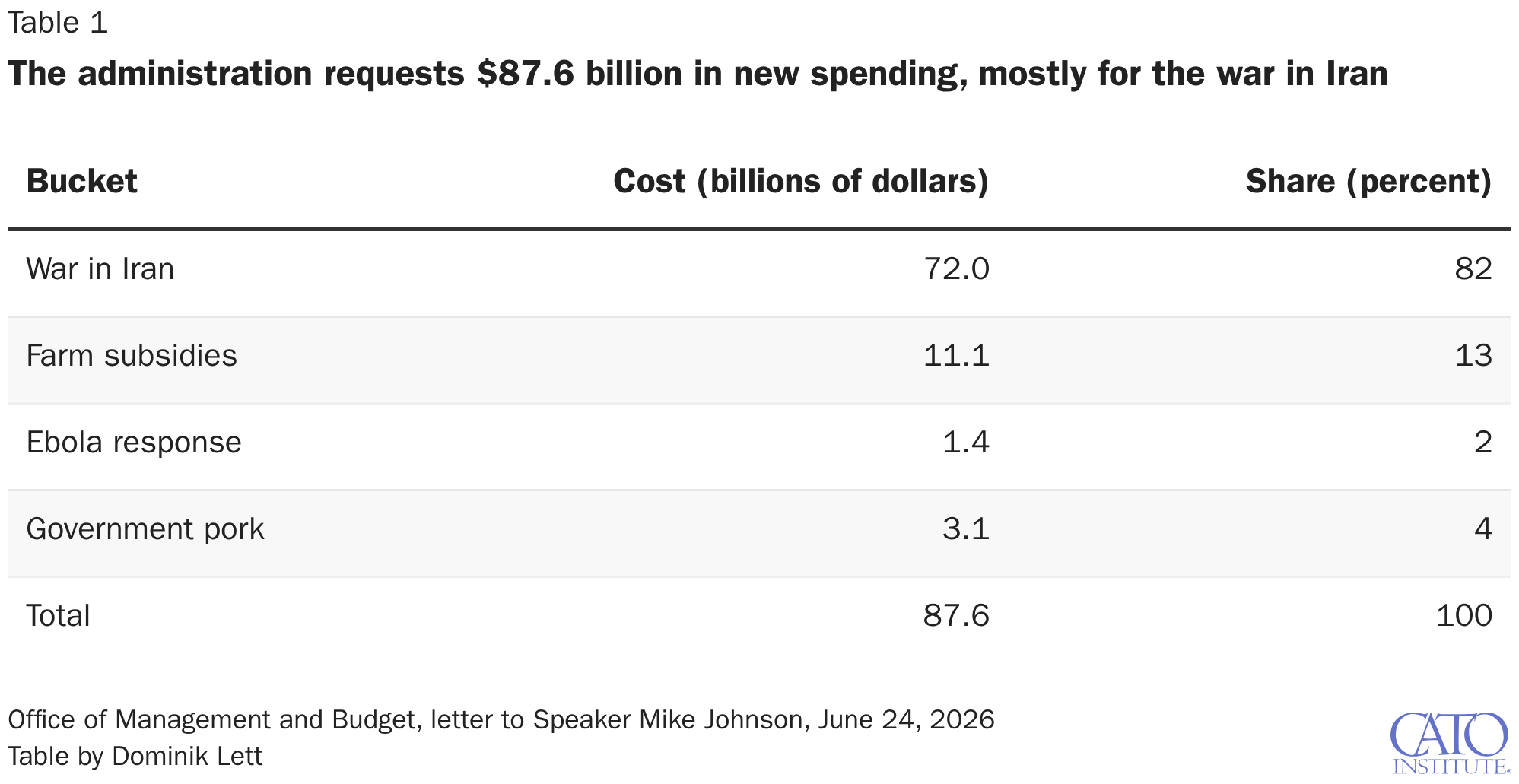
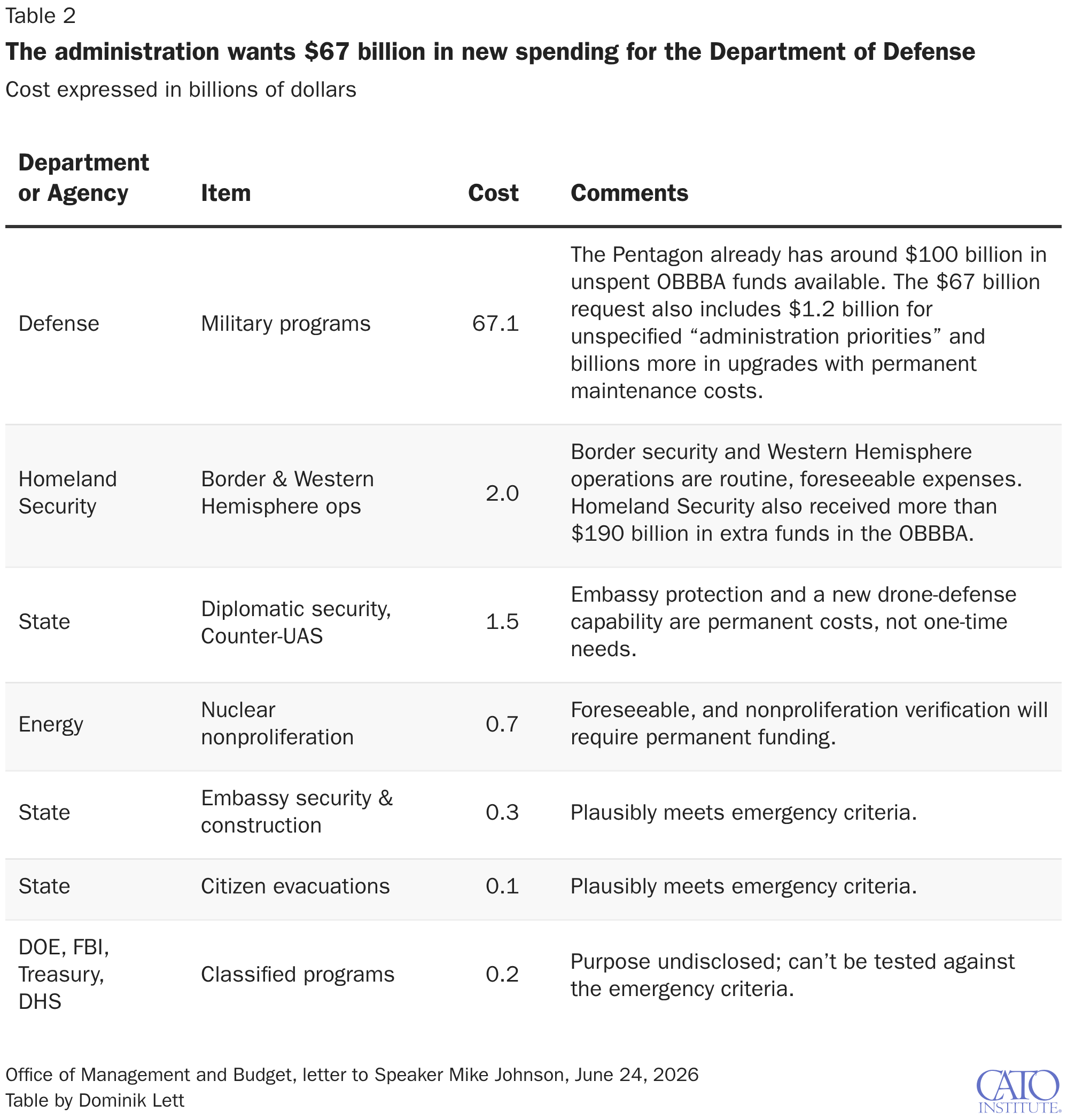
The war in Iran claims the largest share of spending, with the Department of Defense alone receiving a whopping $67 billion. As my colleague Benjamin Giltner explains, at least a quarter of the supplemental would finance ongoing operations, adding to “the roughly $113 billion this war has already cost.” The administration also requests $21 billion to replenish depleted munitions; $1.2 billion for unspecified “administration priorities”; and $12 billion for classified programs. It is doubtful that all of these qualify as emergencies.
Another $2 billion goes to the Coast Guard for border security, only tangentially related to the war. And the request omits any funds for repairs to damaged bases—a cost that would push the price tag higher still. Congress should be skeptical of approving emergency designations for many of these line items. America has a long history of military overspending and irresponsible wartime budgeting.
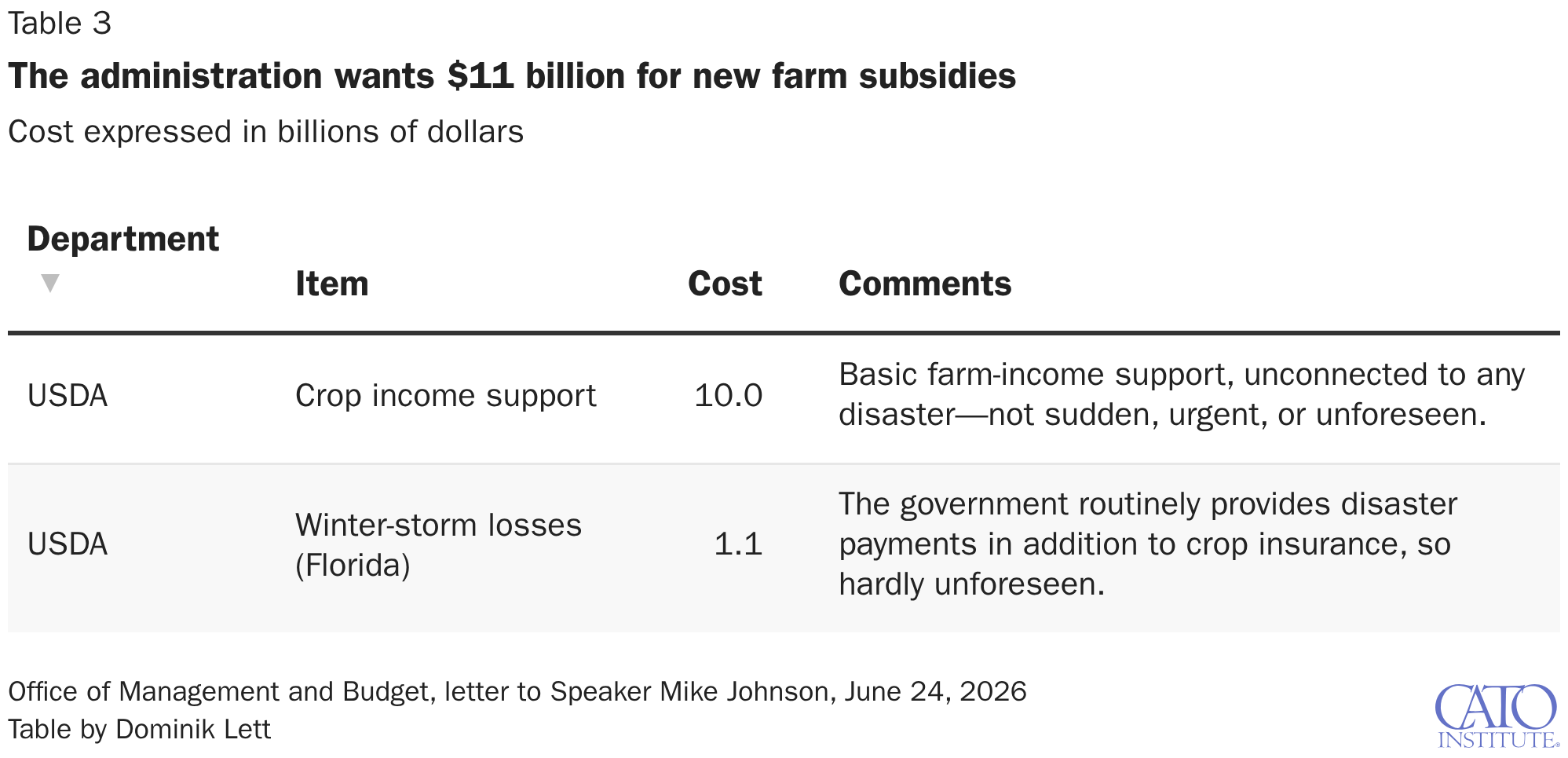
The second bucket is farm subsidies (Table 3). Congress routinely uses “emergency” supplementals to pile on new farm aid. This time around, the administration wants $10 billion in economic assistance for row and specialty crops planted this year, plus $1.1 billion for producers, largely in Florida, hit by last winter’s storms. Neither qualifies as an emergency. Crops follow a predictable annual schedule, weather losses are insurable, and this kind of subsidy is already a permanent fixture in the budget. The federal government already spends $26 billion each year on farm subsidies, and that spending is on the rise, before considering one-off supplemental plus-ups like those proposed by the administration. Besides, this is farm policy that belongs in the farm bill or annual appropriations, not a war supplemental.
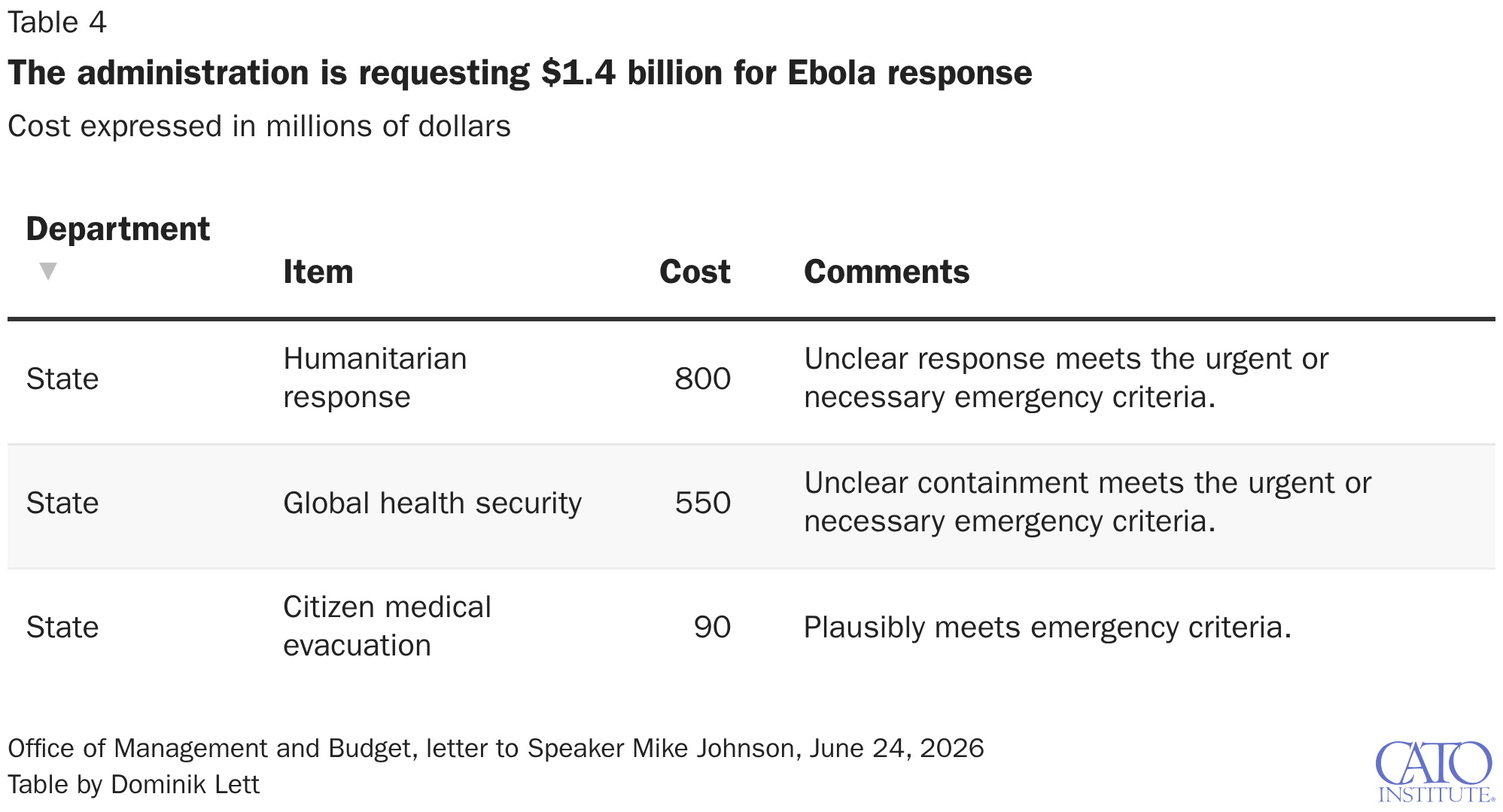
The third bucket is international disease response, prompted by the Ebola outbreak in Uganda and the Democratic Republic of the Congo (see Table 4). Arguably, it meets the sudden, unforeseen, and non-permanent prongs of the test. Yet whether it is necessary or urgent is far from clear. By the CDC’s own assessment, the risk of spread is “very low,” and even if it reaches US shores, the risk of community spread is “also low.” It thus seems premature to spend $1.4 billion here, especially when the federal government already spends more than $12 billion a year on global health funding across several budget accounts.
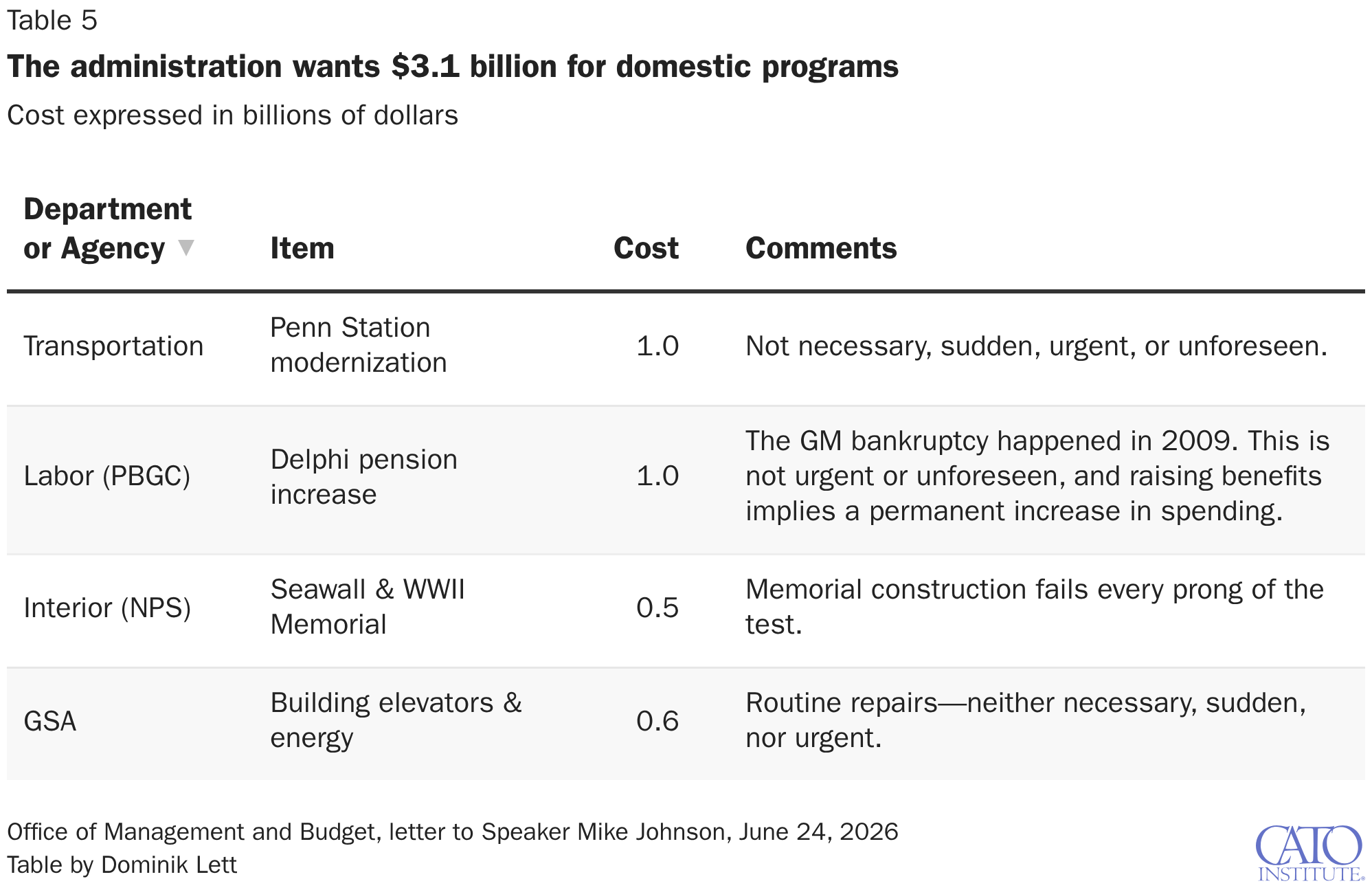
The final bucket is classic pork: local subsidies and parochial priorities that didn’t make the cut in regular appropriations (see Table 5). For example, the administration requests $500 million for the National Park Service to renovate the Tidal Basin Seawall and World War II Memorial in DC. That is not a necessary, sudden, urgent, or unforeseen use of funds by any stretch. Neither is the full $1 billion the administration wants for expedited Penn Station modernization, nor the $600 million ask for elevator and energy upgrades in federal buildings. Nor the $1 billion to raise benefits for pensioners affected by General Motors’ 2009 bankruptcy. None of this merits the emergency label or new deficit spending.
Absent offsets, every dollar of this supplemental would be deficit-financed. And borrowing is not free: $87.6 billion borrowed in FY2026 would add $38 billion in interest through 2036. That pushes the supplemental’s true price tag closer to $126 billion.
More War Spending Is Hard to Justify
Strip away the pork, the farm subsidies, and the Ebola money, and the core of this request is hard to justify. Base discretionary defense spending already approaches $1 trillion a year, and last year’s reconciliation law—the One Big Beautiful Bill Act—added more than $150 billion on top. The military is not starved for resources. Any case for more military spending that rests on threats elsewhere, such as replenishing munitions for a future fight with China, is really a case for prioritizing within the existing budget. If replenishing munitions is a genuine long-term national priority, then lawmakers can fund it within the regular budget with offsets.
Worse, if Congress reliably covers the costs of every conflict on an emergency basis, it cheapens the decision to start one, at least in how the executive branch makes decisions. In effect, Congress would be rewarding the administration for launching a pointless, costly war, with a train station and a pension bailout thrown in for good measure.
Reject It, or Offset It
Congress should reject this request. Most of it does not merit the emergency label, and America cannot afford $126 billion in new borrowing amid $2 trillion deficits. If legislators insist on passing some version of it, they should strip every line item that is not a genuine emergency and offset the rest dollar-for-dollar. No offsets, no deal.
The author would like to thank Eleanor Barrett for her assistance with this piece.