

For over 120 years, semi-automatic rifles have been for sale to the public. Americans have been able to walk into a store and buy one since March 1903, when Winchester introduced its Model 1903 self-loading rifle — the first commercially sold semi-automatic rifle in the United States. These early semi-autos were sold through ordinary sporting goods stores with what anti-Second Amendment activists today described as “large capacity” magazines. Texas Ranger Frank Hamer’s .35-caliber Model 8 carried a special-order 15-round magazine bought from a sporting-goods store in Austin.
It’s only been since the late 1980s and the rise in popularity of the semi-automatic ArmaLite Rifle Model 15 (a.k.a., the AR-15) and other civilianized versions of other modern sporting rifles that gun rights groups, in concert with states like California, have sought to ban the sale of such weapons. The fight between pro- and anti-modern sporting rifle advocates over whether such weapons have or lack protection under the Second Amendment now appears headed for a climax during the Supreme Court’s next term, which begins October 1, 2026.
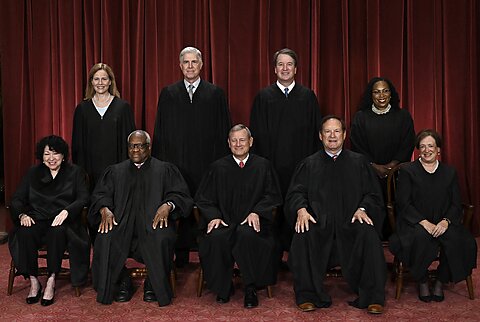
Today, the Court released its order list of cases it has agreed to hear, and among those cases are Viramontes v. Cook County and Grant v. Higgins—AR ban-related lawsuits in Illinois and Connecticut, respectively. The Court’s action comes almost two months after the Trump Justice Department filed suit against the city of Denver and the state of Colorado over the former’s “assault weapons” ordinance and the latter’s high-capacity (15+ rounds) magazine ban. It’s the first time the DoJ has filed suit in support of the rights of American gun owners.
And in the Commonwealth of Virginia, Lancaster County Circuit Judge John Martin issued a preliminary injunction barring the Virginia State Police from enforcing the recently passed “assault weapons” ban supported by Governor Abigail Spanberger (D‑VA) and her fellow Democrats in the state’s legislature. That law was due to take effect on July 1. In contrast to the federal cases, the plaintiffs fighting the Virginia law have cited the language of the commonwealth’s constitution, not the federal Second Amendment, as the basis of their challenge—though the specific section of Virginia’s constitution they cite draws directly from the language of the Second Amendment itself.
These state and federal legal battles will play out over the next several months, but in Virginia it seems likely that a Virginia Supreme Court decision on the status of any preliminary injunctions will have run its course well before the federal Supreme Court issues any ruling in the combined Viramontes-Higgins case.
The argument that anti-modern sporting rifle advocates advance in support of such bans is that the type of rifles in question can injure or kill people more quickly and on a larger scale than other firearms.
The existing data tell a more complex story.
In January 2026, the RAND Corporation issued its findings on this and a related question (magazine capacity as a casualty driver). The conclusions:
“Evidence that assault weapon bans may decrease school shooting injuries is limited. Evidence for the effect of assault weapon bans on mass shootings is inconclusive. Evidence that high-capacity magazine bans may decrease mass shootings is limited.”
The congressionally mandated study of the 1994–2004 federal “assault weapons” ban found no measurable impact on crime, in part because the banned guns were used in as little as two percent and at most eight percent of armed violent crime incidents prior to the ban becoming law. Simply stated, AR-15s or their equivalents (civilian versions of the AK-47, for example) have never been the central gun violence problem in America.
But perhaps the most important fact in this debate is the one that rarely gets mentioned. Criminals don’t care about gun laws, which is why, on almost a daily basis, I get press releases like this one from the Justice Department that remind me of that reality.
Denying law-abiding Americans access to the firearm of their choice for self-defense, which they’re entitled to under the Bill of Rights, is no deterrent to violent crime. Instead, it’s simply a prescription for creating still more victims of armed, violent criminals. Over the next few months, we’ll discover where judges in Virginia and on America’s highest court stand on the issue.